Skip to content

Product

Player reviews, turned into data you can decide with

Ludopsy shows you not just what players said, but how it compares, why it happens, and how much it matters.

How it works

From reviews to evidence

Start with the games: yours, your reference games, or a whole genre. Any game with public reviews works, with no SDK and nothing to integrate.

  1. What players experienced

    Reviews go through our proprietary workflow: purpose-built models, grounded in player-psychology expertise, score every review on the same 50+ metrics, so every game is measured the same way.

  2. How it compares

    Every metric is ranked within its genre and across the full database, so you know what's normal.

  3. Why it happens

    Within each metric, themes emerge from the game's own reviews, 400+ per game, alongside deep summaries and verbatim quotes. All of it traces down to individual reviews.

  4. How much it matters

    Every review becomes quantified data and is combined with game and player metadata, so impact is assessed statistically, not just by how often something comes up. The same data reveals player segments.

  1. Step 1 of 5

    The library

    Where does every game stand?

    Every analyzed game in one view: its score, what to learn from it, and where its opportunity is. Hover any insight to see the player quote behind it, or open a title to go deeper.
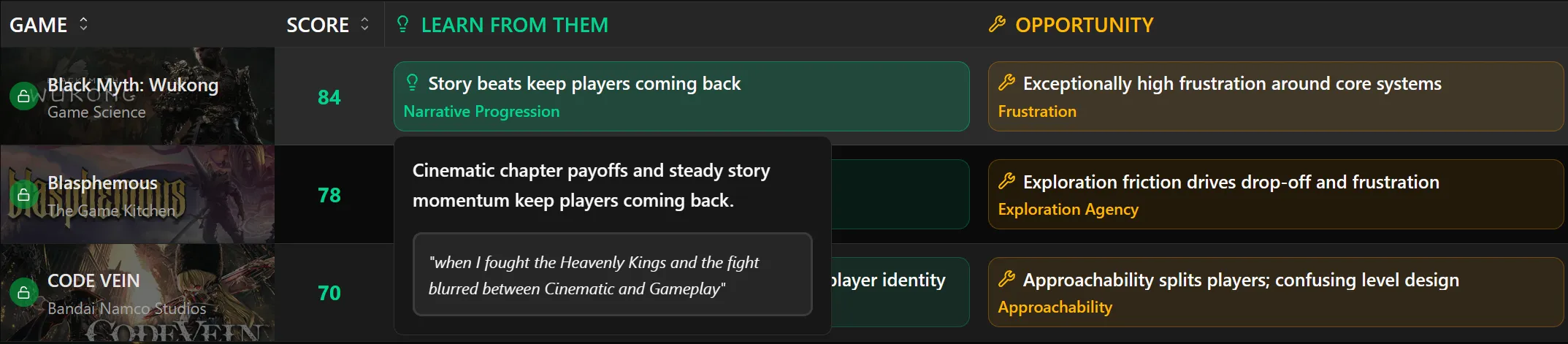
    The Game Intelligence Hub: three games with their score, a learn-from-them insight and an opportunity insight, with one insight opened to show its summary and the player quote behind it
  2. Step 2 of 5

    Benchmarks

    Is this normal for the genre?

    Every topic ranked against the genre and the full database, with how opinion splits and how much it moves players.
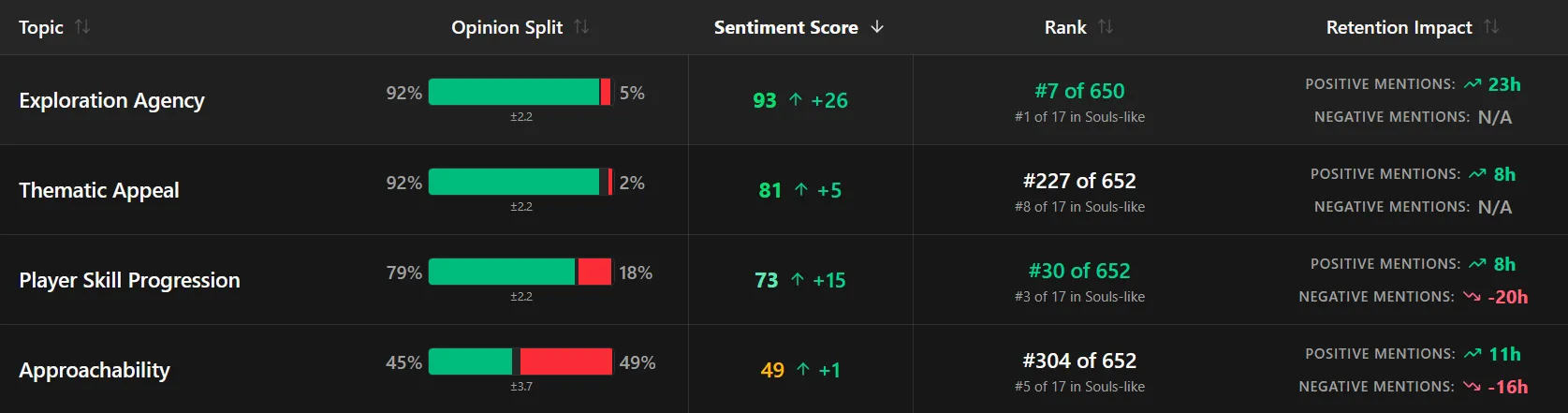
    A game's topics with opinion split, sentiment score, rank in the database and in its genre, and impact on playtime
  3. Step 3 of 5

    Drill-down

    Why did players feel this way?

    Each metric opens into the themes behind it: what players mean by each one, how many reviews raised it, and the verbatim quotes, traceable to individual reviews.
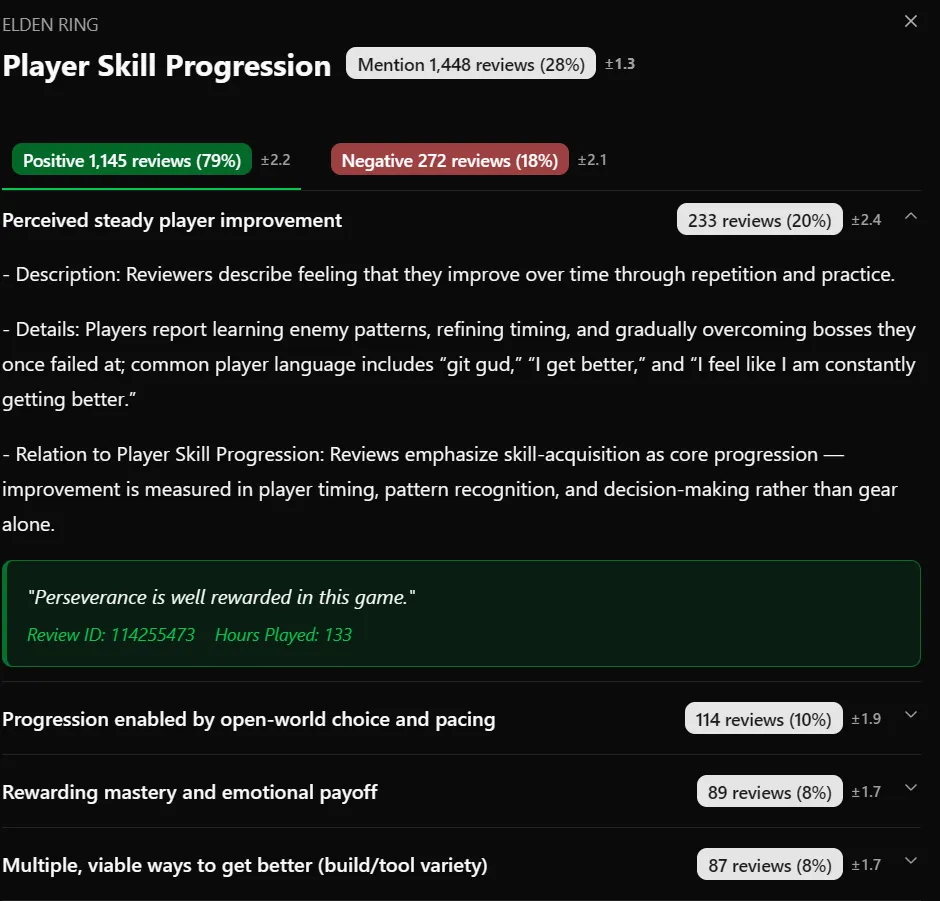
    One metric for one game, split into positive and negative reviews and broken into themes, with one theme opened to show its description, details, review count and a verbatim quote
  4. Step 4 of 5

    Player segments

    Who are these players?

    Players are grouped statistically by how they scored on every metric, separately for each game. Open any segment to see what motivates these players, how they play, and which experiences keep them playing, grounded in what they actually said.

    Mira “The Wandering Sightseer”

    A breadth-first adventure grazer

    “…the prospect of discovering a new piece of lore, the flavor text on a dope item, a valuable upgrade… made me never waver in determination to see what was around the next corner.”
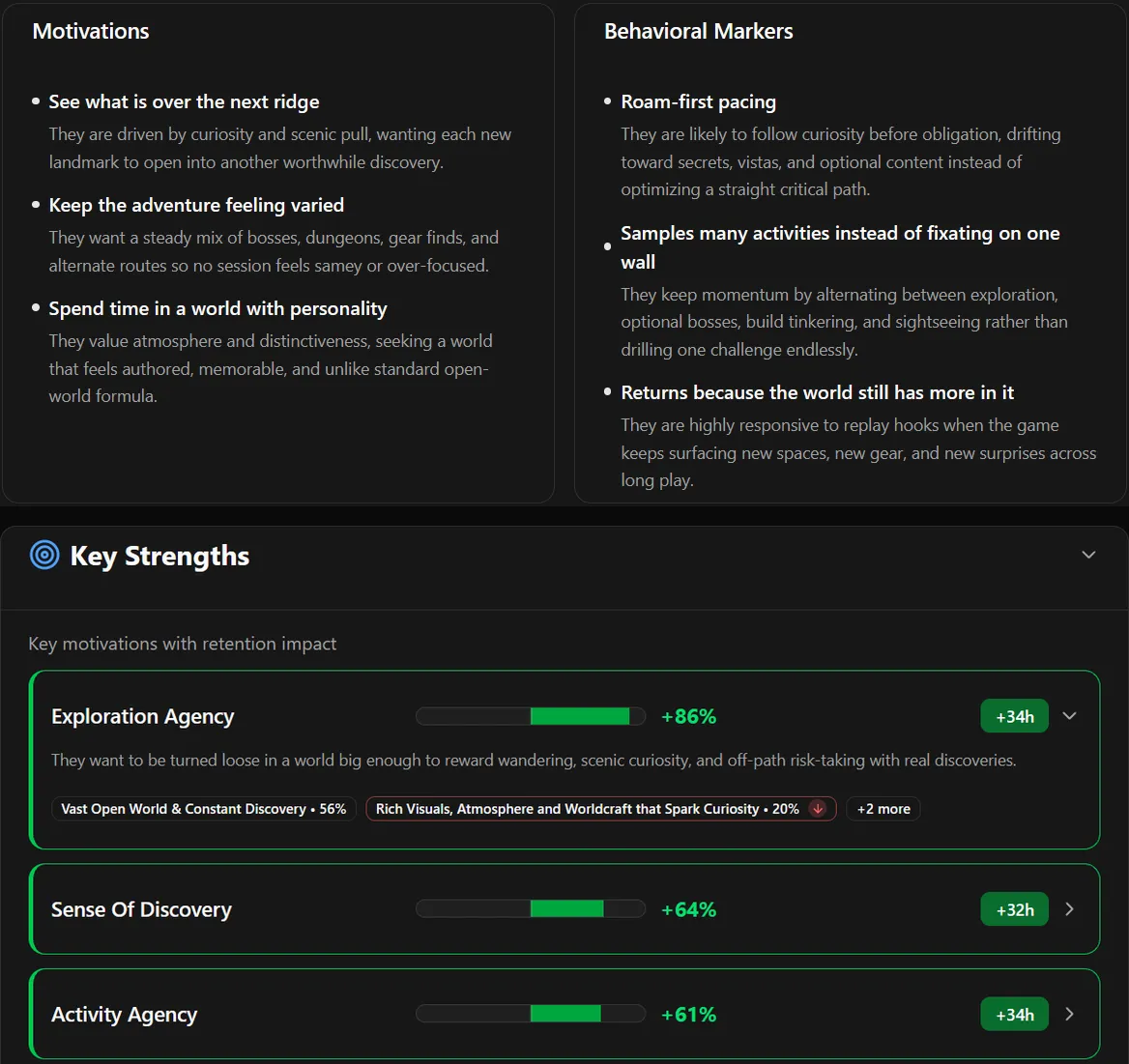
    One player segment: its motivations and behavioral markers, and its key strengths, showing how much more this segment values each motivation than the average player and the playtime linked to it
  5. Step 5 of 5

    Ask Gabe

    What about the question no dashboard covers?

    Ask Gabe in plain language. Behind it, two agents work together: a researcher that finds the evidence across every game in your plan, and an analyst that runs the numbers. Every answer cites its sources and marks each claim as data, inference or opinion.

    • “How risky is it to change the protagonist in a sequel?”
    • “Which onboarding problems in tactics games actually cost playtime, and which are just loud?”
    • “We're pricing a 12-hour roguelite at $40. How do players judge value at that price in similar games?”
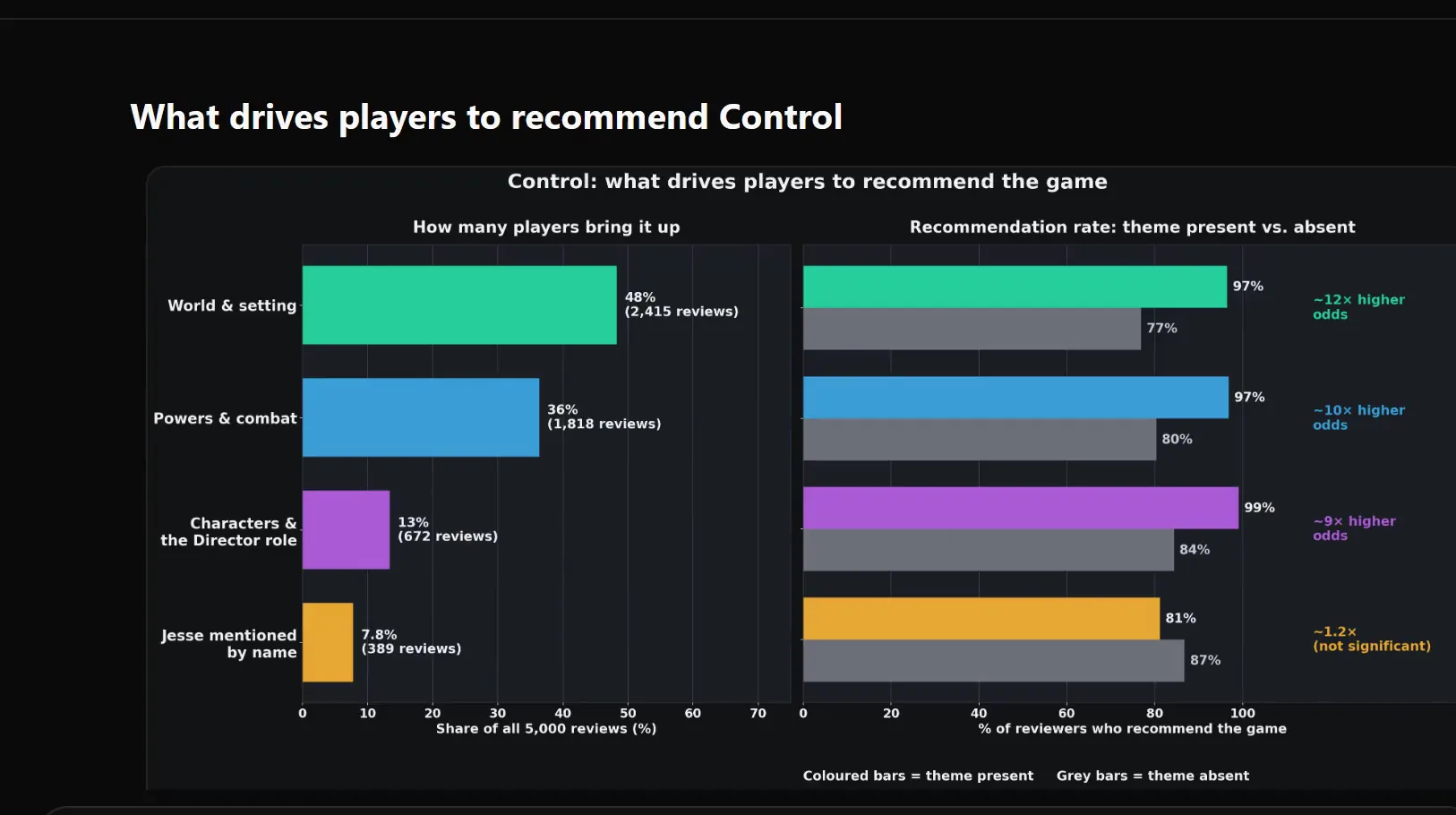
    Gabe answering whether changing the protagonist in a Control sequel is risky: a short bottom line, a chart of what drives players to recommend the game, topic scores ranked against the database, then a click on a topic that opens its detail in the Ludopsy dashboard
The Game Intelligence Hub: three games with their score, a learn-from-them insight and an opportunity insight, with one insight opened to show its summary and the player quote behind it

The framework

One language for player experience

Grounded in player-motivation research, the framework spans the player experience, from core experience to monetization to player motivations, and gives your team one shared language for it.

Custom metrics built for your questions are available on request.

A number means nothing without a benchmark.

You send
The decision you're weighing and your genre.
You get
A two-page report built from comparable games already in our library.

Free. We take a limited number each month, review every request, and deliver within 48 hours of approval.