How Important Is Theme in Tactics Games?
We analyzed 100K reviews of 20 tactics games. Theme is loud in the genre, but it is mostly a risk to manage, not a lever that wins players.
By Ahmet Uysal
Star Wars: Zero Company combines one of my favorite genres with one of my favorite IPs. It was great, but it also raised a question: how critical is theme in this genre?
This is exactly the kind of question we built Ludopsy for. So we analyzed the 20 tactics games in our database, benchmarked against 554 Steam games: 100K reviews from tactics games, compared against 2.7M+ reviews, measured on thematic appeal alongside 50 other metrics.
The short answer
Theme is loud in tactics games, but systems matter more. Players talk about theme 1.4x more than in the rest of Steam, yet they talk about strategic choices, depth, balance and progression more than twice as much.
And theme works mostly as a risk, not a lever. Criticism of theme cuts recommendation odds by 50%, while praise lifts them by 38% (for strategic choices it’s 127%). The games that got hurt didn’t fail by being too light or too dark: they broke what fans expected from the franchise.
1. Theme is loud, and most games execute it well
Players talk about theme in 31% of tactics reviews, against 22% for the rest of the Steam catalog, 1.4x more theme talk. However, they talk about systems more: strategic choices, gameplay depth, balance and power progression come up more than twice as often.
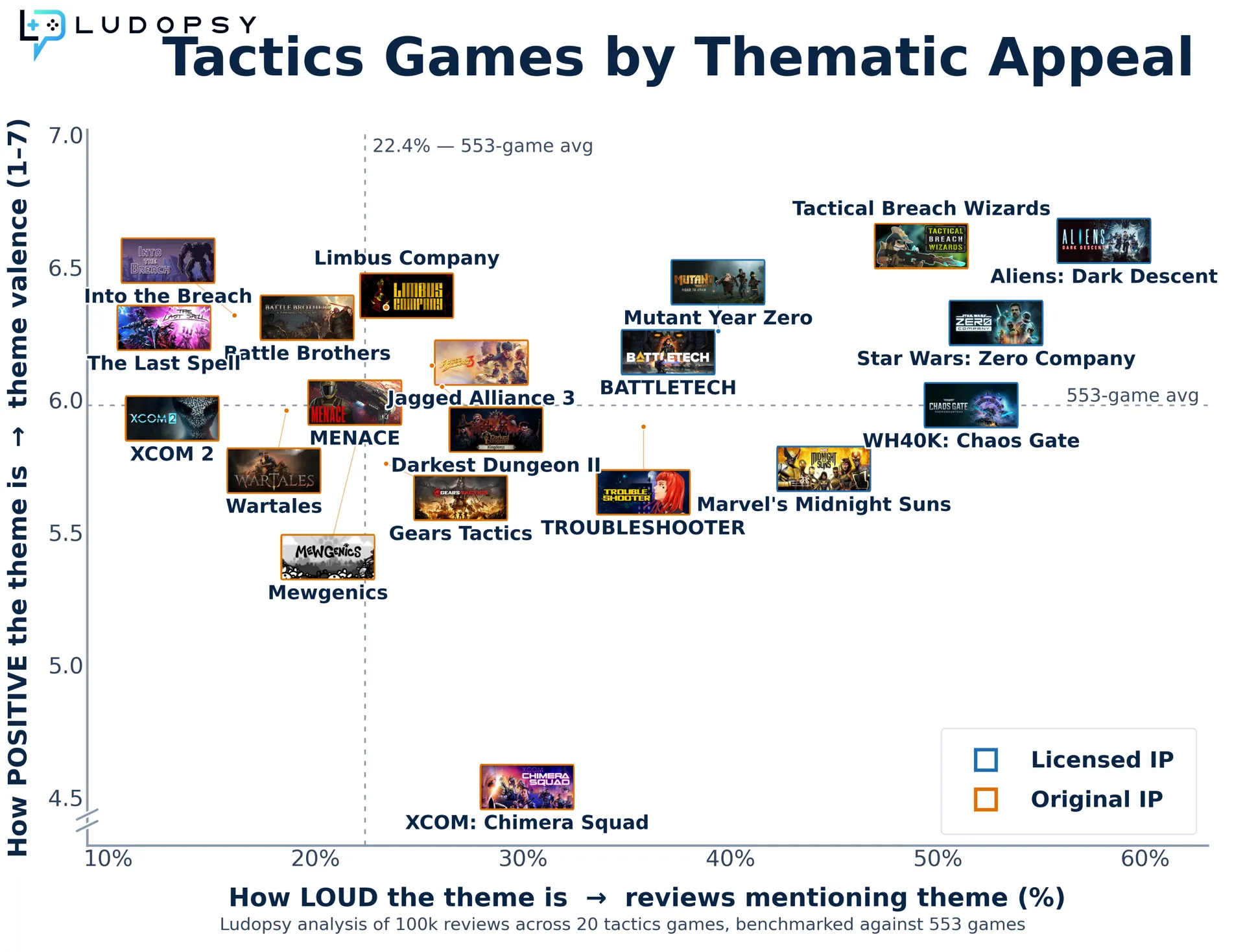
Here is how loud (mention rate) and how positive (1–7 scale) each game’s thematic appeal is. Note that the vertical axis doesn’t start at 1, so differences look larger than they are.
2. Licensed IPs bring even more theme talk
The six licensed-IP games cluster on the right of the graph. Almost one in two of their reviews brings up the theme, a 47% average mention rate, and the talk is generally positive, above the database average. Midnight Suns is the exception.
Within thematic appeal, IP fidelity is the most discussed aspect for licensed games:
“This is an exceptional game that treats the source material with great respect.” (Aliens: Dark Descent)
“X-Com in Star Wars Universe!!! Thats what I wanted, Thats what I get.” (Star Wars: Zero Company)
3. The best games make the systems serve the theme
Aliens: Dark Descent leads on thematic appeal. Gameplay systems that reinforce the theme get high praise, along with the immersive atmosphere it carries over from the IP.
“Even though you have this squad of marines that can dice a runner, you still get scared when the motion detector goes off.” (Aliens: Dark Descent)
Tactical Breach Wizards does something similar: its systems feel in harmony with the narrative and its irreverent tone.
“The setting makes sense and is consistent in the way it’s presented, which is more than I can say about many games I’ve played over the years.” (Tactical Breach Wizards)
Breaking the theme can backfire, though. WH40K: Chaos Gate shows some ludonarrative dissonance:
“Nothing in this game screams ‘I’m a freaking Grey Knight who slaughters demons.’” (WH40K: Chaos Gate)
4. Licensed IPs are more narrative-driven
Licensed-IP games lean more on narrative and get more narrative talk (35% vs 24%), with WH40K: Chaos Gate the exception.
5. An original IP beats them all on narrative
Tactical Breach Wizards is the positive outlier again: 62% of its reviews talk about narrative, and 97% of that talk is positive. An original IP that beats every licensed game. Star Wars: Zero Company comes second, pairing high volume (42%) with high positivity (83%).
6. Licensed IPs replay less, and carry a pricing burden
Licensed-IP games have somewhat lower replayability than the rest, in both sentiment and playtime data. They also have lower pricing sentiment, though their higher price is a confound. A higher price also comes with lower tolerance for technical issues.
7. Nobody delivers meaningful story choices yet
The genre’s existing narrative style generally lands well. But no game stands out for giving players truly meaningful story choices. Given how close the genre sits to RPGs, that’s an open opportunity.
8. XCOM: Chimera Squad is the cautionary tale
In Chimera Squad, theme is the most discussed topic, but only 60% positive, well below both the genre and the database average.
The negativity comes from losing XCOM’s dark, gritty atmosphere and from a juvenile tone (another “rainbows in Diablo 3” moment). Marvel’s Midnight Suns draws similar complaints about a juvenile tone, which hurts its thematic appeal, especially for a licensed IP.
That doesn’t mean tactics games need to be grimdark. Tactical Breach Wizards is irreverent and lands well. The problem in the other games was breaking franchise expectations and the tonal mismatch that followed.
9. Theme affects recommendations, but only a little
When we hold the other aspects of a review constant (a very conservative test), mentioning thematic appeal lifts recommendation odds by 38%, compared with 127% for strategic choices. Criticizing the theme cuts the odds by 50%. Disliking the theme is also linked to 26% less playtime, with no meaningful upside when players like it.
There’s no evidence of a link between thematic appeal and popularity or sales. These are all relatively successful games, though, so there’s a ceiling effect.
10. Study Tactical Breach Wizards
Tactical Breach Wizards stands out from the rest of the genre on many dimensions: it’s the most positive and most differentiated game in it. If you’re making a tactics game, study it.