Why Do Games Fail?
A hit needs creative direction, commercial reality and team capability aligned. Lose one overlap and you get a predictable failure mode.
By Ahmet Uysal
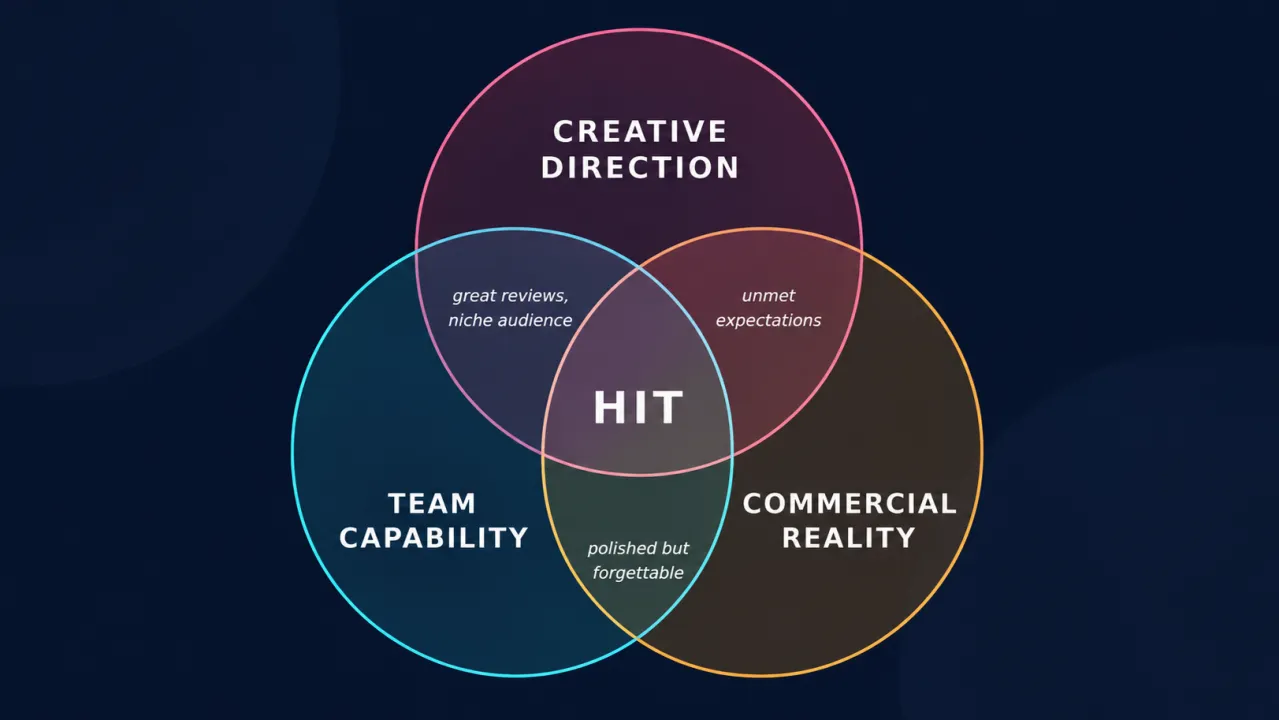
A game needs three things aligned to be successful: creative direction, commercial reality (audience and budget), and team capability (execution). Lose one overlap, and you get one of the predictable failure modes that many industry veterans have experienced firsthand, probably multiple times.
Jason Schreier’s piece on Suicide Squad (Bloomberg) shows examples of each gap. None of this is a knock on the developers. Rocksteady is an elite team, and the candor in Schreier’s reporting shows real self-awareness. The failure is structural, and it repeats because the structure repeats.
When creative direction and commercial reality pull apart
“Rydby understood why Warner Bros. was growing nervous about recouping its investment. But he worried that the game was losing its soul along the way.”
This is direction and commercial reality pulling apart. When creative and execution align but the audience piece is missing, games earn great reviews but can’t reach a large enough audience to sustain them. What generally follows is layoffs or a shutdown, with players lamenting the loss, because the game was genuinely good for a niche audience.
Players often say “they didn’t market it well enough,” but that’s rarely the whole story. The game wasn’t built for a larger audience from the start: either there was no alignment between direction and audience reality at greenlight, or it drifted away during development.
This happens because confidence in the direction grows while audience assumptions go untested. The team strongly believes it’s making the right game, until it’s too late.
“There was definitely a sense when we first moved on to it — arrogance is the wrong word, but a confidence,” Armstrong said. “We’re coming back off hit after hit. Of course we’ll be able to do this.”
And on how the reception landed:
“Armstrong said that after the game came out in February 2024, he was surprised by how negative the reactions were.”
That confirms the scale of the misalignment: the signals were missed so completely that the team was blindsided.
When creative direction and team capability pull apart
Later, the gap between creative and execution surfaces:
“It became clear that Rocksteady, one of the most elite teams in the industry at making single-player action-adventure games, was not set up to develop a multiplayer shooter with endless content.”
When this happens, the outcome is a game that doesn’t meet expectations. Suicide Squad had both gaps: audience and execution.
The root tension
“It used to be passion projects that you loved and hoped other people loved too. When they did, it was such an amazing feeling.”
You can work this way as an indie. But large studios can’t bet hundreds of millions on one person’s taste, no matter how great or accomplished. It’s an extremely expensive test of a single thesis, “do people love what I love?”, and the industry keeps paying for it.